
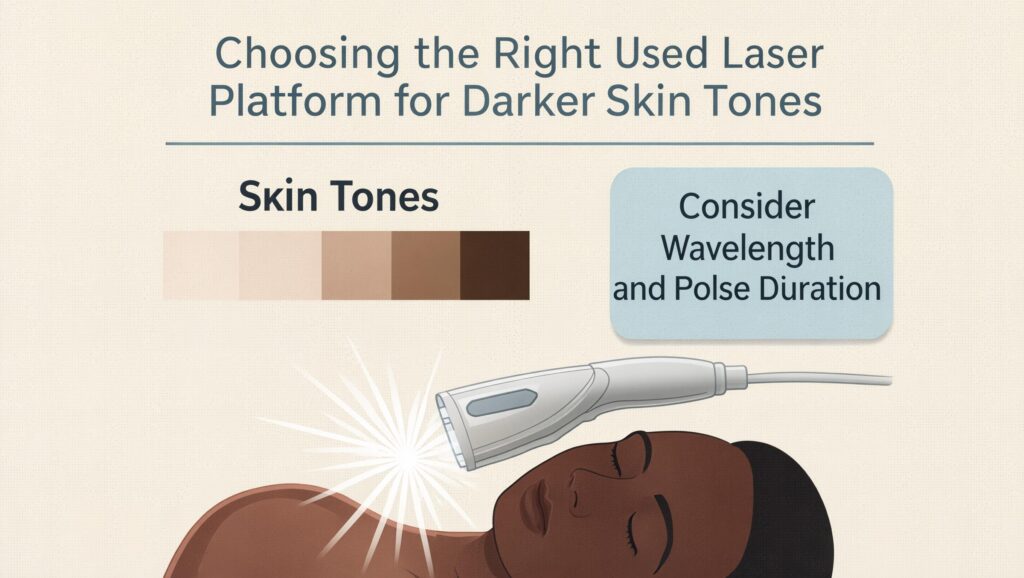

For a practice that serves a diverse patient base, choosing between a diode and an Alexandrite laser is a safety decision as much as a business one. The wavelength you pick changes how the laser interacts with each skin tone, and that matters most when treating darker skin. Both platforms deliver excellent results, and both appear regularly on the used market at attractive prices. But they behave differently across skin types, and the difference becomes
critical exactly where the margin for error is smallest. A platform that is ideal for one patient population can be the wrong choice for another. In this blog, you will learn how diode and Alexandrite wavelengths differ, how those differences affect their use on darker skin, and what to weigh when evaluating a used laser for a diverse
practice.
Why Wavelength Decides Everything Here
The entire question comes down to one principle. Every hair removal laser works by targeting melanin, the pigment in the hair follicle. The laser’s energy is absorbed by that melanin, heats it, and disables the follicle. The problem is that melanin also lives in the skin itself, and the darker the skin, the more of it there is at the surface. So the safety of any given wavelength comes down to a single question. Does the energy pass through the surface melanin to reach the follicle, or does the surface skin absorb it along the way? A wavelength that the skin absorbs heats the epidermis, and that is what causes burns and pigment damage on darker skin. This is why matching the wavelength to the skin tone is
more important than the brand on the machine.
The Alexandrite Laser: Fast and Precise, but Narrow
The Alexandrite laser operates at 755 nm, the shortest of the common hair removal wavelengths.
What It Does Well
At 755 nm, the Alexandrite has the highest melanin absorption of any hair removal laser. That makes it fast, precise, and highly effective at targeting dark hair on light skin. For patients in Fitzpatrick skin types I through III, it produces excellent results quickly, which is why it is prized in practices serving a predominantly light-skinned clientele.
Where It Becomes a Problem
That same high melanin absorption is exactly what makes the Alexandrite risky on darker skin. The wavelength cannot tell the difference between the melanin in the hair follicle and the melanin in the skin surface, so on darker skin it heats both. In Fitzpatrick types IV and above, that surface absorption increases the risk of burns, hyperpigmentation, and
hypopigmentation. The clinical guidance on this is consistent. A practice using only Alexandrite technology cannot
safely treat the full Fitzpatrick spectrum. For darker skin tones, it is the wrong tool.
The Diode Laser: The Safer Choice Across More Skin Tones
The diode laser operates at a longer wavelength, typically around 808 to 810 nm.
What the Longer Wavelength Changes
That longer wavelength penetrates deeper into the skin and is absorbed less by surface melanin. In practical terms, it bypasses more of the epidermal pigment and delivers its energy to the follicle rather than the skin surface. That single difference is what makes the diode meaningfully safer than the Alexandrite across a wider range of skin tones.
Where the Diode Fits
The diode is generally considered appropriate and effective through the middle of the Fitzpatrick range, into type IV and workable in type V. It is one of the most widely used hair removal lasers in professional settings precisely because of this versatility. For a practice that treats medium to darker skin tones, the diode is the stronger and safer of the two platforms in this comparison.
The Honest Answer: For the Darkest Skin, Look Beyond Both
Here is the part a straight diode-versus-Alexandrite comparison leaves out, and it matters too much to skip on a safety topic. For the darkest skin tones, Fitzpatrick types V and VI, the safest wavelength is neither the Alexandrite nor the diode. It is the Nd:YAG at 1064 nm. This longer wavelength largely bypasses epidermal melanin altogether and eaches the follicle with the lowest risk of surface damage. That is why it is widely regarded as the gold standard for the darkest skin. A peer- reviewed clinical study on rotational laser treatment describes beginning treatment with Nd:YAG
specifically for Fitzpatrick types IV, V, and VI before switching to shorter wavelengths as the hair thins.
The practical takeaway is this. If your practice genuinely serves the full range of skin tones, the most reliable answer is not one wavelength at all. The platforms that handle every skin type safely are multi-wavelength systems that combine diode, Alexandrite, and Nd:YAG in a single device, letting the provider match the wavelength to each patient. Many of these platforms are available on the used market and are worth prioritizing over any single-wavelength machine if your clientele is diverse.
What to Check When Buying a Used Platform for Diverse Skin Tones
Once you know which technology fits your patients, the used-purchase checks follow naturally. Before committing to any used laser for sale, confirm the following.
● The wavelength matches your actual patient base. An Alexandrite-only machine at a
great price is no bargain if a meaningful share of your patients have darker skin.
● Multi-wavelength capability, if your clientele is diverse. A combined diode,
Alexandrite, and Nd:YAG platform gives you the range to treat everyone safely from one
device.
● Verified energy output. On darker skin especially, delivering the correct energy is a
safety issue, so the machine should be tested to confirm it performs to specification.
● Handpiece and cooling condition. Skin cooling protects the epidermis during
treatment, which matters most on darker skin. Confirm the cooling system and
handpieces are in good working order.
● Documented service history. A machine with a clear maintenance record is one you
can trust to deliver consistent, safe energy.
Match the Platform to the People You Treat
The diode-versus-Alexandrite question does not have one universal winner. The Alexandrite is superb for light skin and the wrong choice for dark skin. The diode is the safer and more versatile of the two across a wider range of tones. And for the darkest skin, the Nd:YAG, ideally within a multi-wavelength platform, is the safest answer of all. The right choice is the one that matches the people who will actually sit in your treatment chair. At The Laser Agent, we carry inspected, verified used platforms across all of these technologies, including multi-wavelength systems built to treat the full Fitzpatrick range safely. If you are evaluating a used laser for sale and want to be sure the wavelength fits your patient
base, reach out to our team. We will help you match the platform to the practice.