
Medical coding can feel overwhelming, especially when hormone-related symptoms don’t fit neatly into a single diagnosis. If you’ve searched for icd 10 perimenopausal symptoms, you’re likely trying to understand how clinicians document this transitional stage for diagnosis, treatment, or insurance billing.
Perimenopause presents a unique challenge in healthcare because it is not always coded under one dedicated ICD-10 diagnosis. Instead, providers often code the specific symptoms or related menopausal conditions affecting the patient.
Whether you’re a medical coder, billing specialist, clinician, or patient trying to understand insurance documentation, knowing the correct coding framework can improve claim accuracy and reduce reimbursement issues.
What Is ICD-10?
ICD-10 stands for the International Classification of Diseases, Tenth Revision, a standardized coding system used worldwide for documenting diseases, symptoms, medical conditions, and healthcare encounters.
In the United States, providers commonly use ICD-10-CM codes for:
- Medical documentation
- Insurance claims
- Billing accuracy
- Clinical reporting
- Treatment justification
Each code helps communicate a patient’s condition in standardized language.
Understanding Perimenopause in Clinical Practice
Perimenopause refers to the transitional years before menopause when ovarian hormone production becomes irregular. During this stage, estrogen and progesterone levels fluctuate significantly.
These hormonal changes can produce symptoms affecting:
- Menstrual cycles
- Sleep quality
- Emotional regulation
- Sexual health
- Metabolism
- Vasomotor stability
From a coding perspective, the challenge is that perimenopause itself is often documented through symptom-specific diagnoses.
ICD 10 Perimenopausal Symptoms Coding Basics
When discussing icd 10 perimenopausal symptoms, clinicians usually select codes that reflect either:
- Menopausal transition disorders
- Specific presenting symptoms
- Related endocrine abnormalities
Because symptom presentation varies, multiple codes may be used for a single encounter. You may read this: Menopause and Anger Toward Husbands: Causes & Support.
Why No Single Universal Code Exists
Perimenopause is a transitional hormonal state rather than a discrete disease.
That means coding frequently depends on what prompted the visit.
Examples include:
- Hot flashes
- Irregular bleeding
- Insomnia
- Anxiety
- Vaginal dryness
Different symptoms may require separate diagnosis codes.
Common ICD-10 Codes Used for Perimenopausal Symptoms
Several ICD-10 categories commonly appear in documentation.
N95 Category (Menopausal and Perimenopausal Disorders)
The N95 category is one of the most relevant groups.
Common codes include:
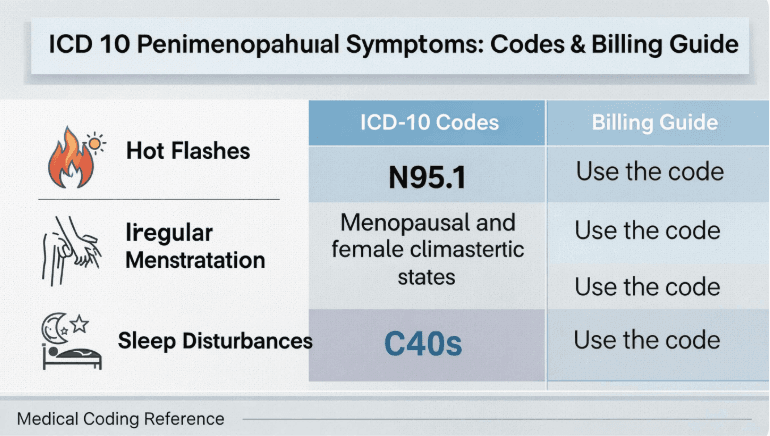
N95.1 — Menopausal and Female Climacteric States
Often used when symptoms are associated with menopausal transition.
Common associated symptoms include:
- Hot flashes
- Night sweats
- Mood changes
- Sleep disturbances
This is one of the most frequently referenced codes related to icd 10 perimenopausal symptoms.
N95.8 — Other Specified Menopausal and Perimenopausal Disorders
Used when symptoms fit menopausal transition but are not fully captured by more specific codes.
N95.9 — Unspecified Menopausal and Perimenopausal Disorder
Applied when documentation lacks symptom specificity.
This code is less ideal because vague coding can increase claim scrutiny.
Symptom-Specific ICD-10 Codes
Many encounters rely on symptom-based coding.
Abnormal Bleeding
Irregular menstrual bleeding is common during perimenopause.
Possible codes may include abnormal uterine bleeding classifications within gynecologic coding categories.
Sleep Disturbances
Sleep problems may be coded separately.
Examples include insomnia-related classifications.
Mood Symptoms
Emotional symptoms may require psychiatric or symptom-based codes.
Common issues include:
- Anxiety
- Irritability
- Depression
- Panic symptoms
Vasomotor Symptoms
Hot flashes and night sweats may justify symptom-focused documentation.
Fatigue
Fatigue is another common complaint that may receive independent coding.
Documentation Requirements for Accurate Coding
Accurate coding depends heavily on provider documentation.
Strong documentation should include:
Symptom Description
The clinician should specify:
- Severity
- Duration
- Frequency
- Progression
Hormonal Context
Documentation may include:
- Perimenopausal stage
- Menstrual history
- Hormone-related observations
Associated Diagnoses
Related conditions may affect coding.
Examples:
- Thyroid disorders
- PCOS
- Depression
- Sleep disorders
Better documentation improves coding precision.
Common Coding Errors
Errors in coding can lead to denials or delayed reimbursement.
Frequent mistakes include:
Using Overly Broad Codes
Unspecified diagnoses may trigger payer review.
Missing Symptom Detail
Lack of symptom documentation weakens coding justification.
Ignoring Secondary Diagnoses
Multiple symptoms often require multiple codes.
Incomplete Encounter Notes
Incomplete notes increase audit risk.
Billing Considerations for Perimenopause Visits
Billing isn’t based only on diagnosis codes.
Reimbursement may also depend on:
- Visit complexity
- Medical necessity
- Time spent
- Procedures performed
- Lab interpretation
Documentation should support both diagnosis and treatment decisions.
Why Symptom Coding Matters
Proper coding serves several purposes.
It helps:
- Support treatment decisions
- Improve reimbursement accuracy
- Track population health trends
- Reduce claim denials
Accurate coding improves clinical and administrative workflows.
Who Uses ICD-10 Perimenopausal Symptom Codes?
These codes are commonly used by:
- Gynecologists
- Primary care physicians
- Endocrinologists
- Medical coders
- Billing teams
- Insurance auditors
Anyone involved in women’s healthcare documentation benefits from coding familiarity.
FAQ
Is there one ICD-10 code for perimenopause?
No. Perimenopause is usually coded using symptom-specific or menopausal disorder codes.
What is the most common code used?
N95.1 is among the most frequently used codes for menopausal transition symptoms.
Can hot flashes be coded separately?
Yes. Depending on documentation, symptom-specific coding may be used.
Why are multiple codes sometimes required?
Patients often present with several symptoms requiring separate documentation.
Does insurance require exact coding?
Yes. Accurate coding supports reimbursement and reduces claim denial risk.
Can perimenopause be billed as a diagnosis?
Often, related menopausal disorder codes are used rather than a standalone perimenopause diagnosis.
Who assigns ICD-10 codes?
Licensed providers and trained medical coders commonly assign diagnosis codes.
Why does coding accuracy matter?
Coding accuracy affects billing, reimbursement, audits, and care documentation.
Conclusion
Coding hormone-related care requires both clinical understanding and documentation precision. Because perimenopause can affect multiple systems, coding often involves symptom-specific classifications rather than a single universal diagnosis.
Understanding icd 10 perimenopausal symptoms helps providers, coders, and billing teams improve claim accuracy while ensuring medical records reflect the true complexity of a patient’s symptoms. Accurate documentation ultimately supports better care and smoother reimbursement.